Omnifunk

Applications

Many tools, one platform

Omnifunk adds complementary applications to your operation on top of the same communications infrastructure. Choose the ones your operation needs today, and add more when you need them. Several of these functions also reach the field team through the PoC App, on Android and iPhone, such as the channel map, messages, video, and emergency alerts.

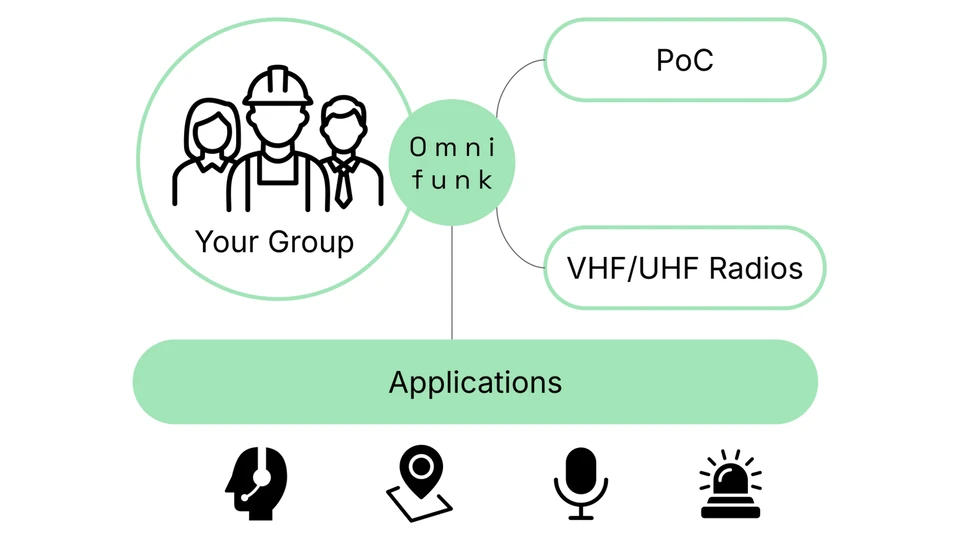
Diagram: the Omnifunk platform connects your team with PoC and VHF/UHF radios, and adds dispatch, location, audio recording, and alert applications

Command and control

Dispatcher

The command center for the whole operation.

A centralized console where an operator sees, hears, and coordinates every user on the network (vehicles, field staff, vessels) in real time from a single screen, with maps, talk groups, and communication history. It receives live video from the field user's phone, so the operator can see the situation before deciding.

Benefits: Full visibility of the operation on one screen · Instant communication with individuals or entire groups · Traceability of every interaction · Visual confirmation with live video

GPS and indoor location

Know where every person and every asset is, at all times.

GPS tracking of people, vehicles, vessels, or mobile assets, with position, route history, and configurable alarms right on the dispatcher's map. Inside buildings and plants, indoor location finds the user where GPS can't reach. With geofencing, the system alerts you automatically when someone or something enters or leaves a zone marked on the map.

Benefits: Constant visibility of fleet and staff · Better routes and travel times · Location indoors too · Automatic alerts in restricted zones

Voice recorder

Evidence and compliance, without the extra work.

Automatic, secure recording of individual and group communications on the network, with storage, search, and playback for audits, compliance, or incident investigation.

Benefits: Objective evidence for incidents or claims · Regulatory compliance · Continuous improvement by reviewing procedures

Security and emergencies

Lone worker (man down)

No one goes unanswered, even working alone.

Monitors staff who work isolated or in risky conditions: it detects falls and immobility, uses check-in timers, and alerts the dispatcher right away if the worker doesn't respond. Unlike the emergency alert, which the user triggers by hand, this one goes off on its own even if the user can't act.

Benefits: Immediate response to accidents with no witnesses · Compliance with workplace safety regulations · Peace of mind for staff in remote areas

Emergency alerts

Help at the push of a button, with absolute priority.

Triggers an emergency alert (with or without audio, video, or location) from any device on the network to the dispatcher. It takes priority over any other communication. The user triggers it manually.

Benefits: Emergency response in seconds · Automatic priority · Exact location of the incident

SIP telephony and PA system interface

One operator, every broadcast channel.

Through the gateway, the platform connects with SIP telephony, intercoms, and IP speakers: the same dispatcher who runs the radio calls an extension or sends mass or targeted announcements.

Benefits: One operator for multiple channels · Instant emergency announcements across a whole facility · Less parallel infrastructure

Operations management

Guard tour control

Security rounds that are verified, not assumed.

Digital management of patrol rounds with geolocated checkpoints, marked manually or automatically, that confirm the guard completed the route, with an alert if a checkpoint is missed.

Benefits: Objective verification that rounds were completed · Fewer blind spots · Automatic reports for clients and audits

Task management

From a dispatched order to proof it was completed.

Assignment, tracking, and closure of tasks or work orders from the dispatcher to field staff, with receipt confirmation and digital proof of completion.

Benefits: Full traceability of every task · Less downtime and rework · Digital evidence (photos, checklists)

IoT sensors and telemetry

Remote monitoring and early alerts, around the clock.

Brings field sensors (temperature, humidity, fuel level, door openings, gas) and vehicle and equipment telemetry into the platform. When a reading goes out of range, the dispatcher gets the alert on the same console used to coordinate the operation.

Benefits: Remote monitoring without constant presence on site · Early alerts that prevent losses · Historical data for maintenance and analysis

Data analytics and AI

Analytics and reports

Turn your operation's data into better decisions.

Visual dashboards with key operational indicators, such as network usage, response times, task completion, and incidents. See trends, spot opportunities, and generate reports to support decision-making.

Benefits: Decisions based on data, not guesswork · Identifies operational bottlenecks · Automatic reports for clients or management

Communication summaries and search

Coming soon

Find what was said, without listening to hours of audio.

Automatically transcribes the network's recorded communications and turns them into text you can search by word, person, channel, or date. At the end of each shift it delivers a summary of what happened: incidents, instructions given, and recurring topics.

Benefits: An incident investigation drops from hours to minutes · Shift reports nobody has to write · Word search across your whole voice history

Keyword and duress detection

Coming soon

Ask for help without the attacker knowing.

The system listens to live communications and recognizes words or phrases your organization defines in advance. It covers two cases: a duress word the user says naturally when someone forces them to talk, and risk warnings mentioned in passing without opening a formal emergency.

Benefits: A silent alert for when triggering an emergency alert would give the victim away · The dispatcher hears what was said before and after · Each organization sets its own words

Which of these does your operation need? Let's talk →