
Omnifunk

Network integration

All your communications on one platform

Omnifunk connects conventional analog radios, digital DMR or TETRA radios on VHF/UHF, and the PoC system into a single infrastructure. Radio integration runs through IP radio gateways: your organization doesn't replace the radio equipment it already has, it connects that equipment to other networks and applications.

Tell us what networks you have today, and we'll show you how to connect them →

Benefits

  • You keep using the radios you already have, now connected to PoC and to other networks, and you add to the channel the staff who only carry a phone.
  • Share infrastructure costs across several organizations, without giving up privacy in their day-to-day communications.
  • The platform adapts to your operation, not the other way around, with flexible applications built to fit. 

Every network is different

Every organization's network architecture is different, shaped by its own operational requirements. Omnifunk adapts to that reality and adds value to the network you already have. Here are two real examples of how that works.

A dispatcher that bridges networks

An organization runs two radios, one conventional and one DMR, with a single dispatcher managing both. During an emergency, the dispatcher bridges the person reporting the incident in the field and emergency services. The organization also needs to cover an area with no DMR reach, but good mobile signal.

Omnifunk integrates all three technologies (conventional, DMR, and PoC) into a single emergency channel. That way, the dispatcher coordinates everyone involved from one point, and can bring the corresponding emergency service onto the channel when needed.

The same architecture can link networks from different organizations into shared channels, for joint emergencies, shared operations, or other announcements.
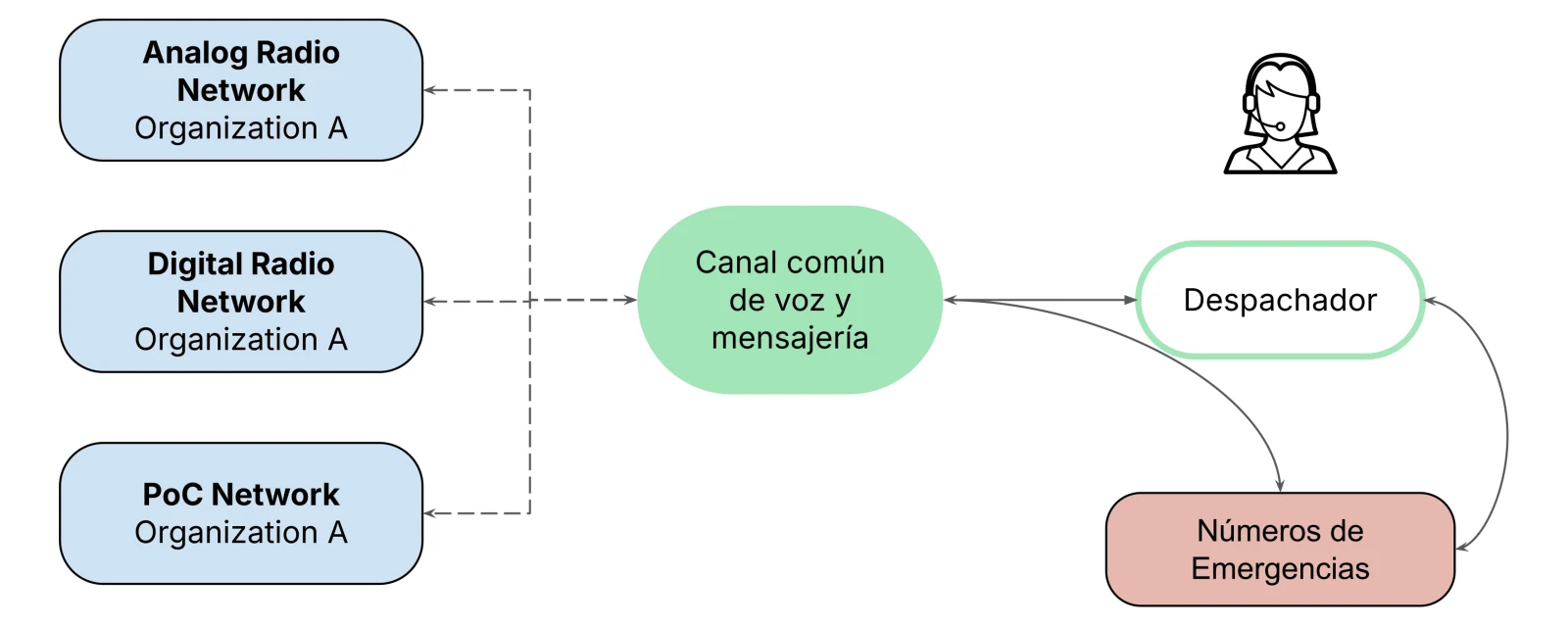
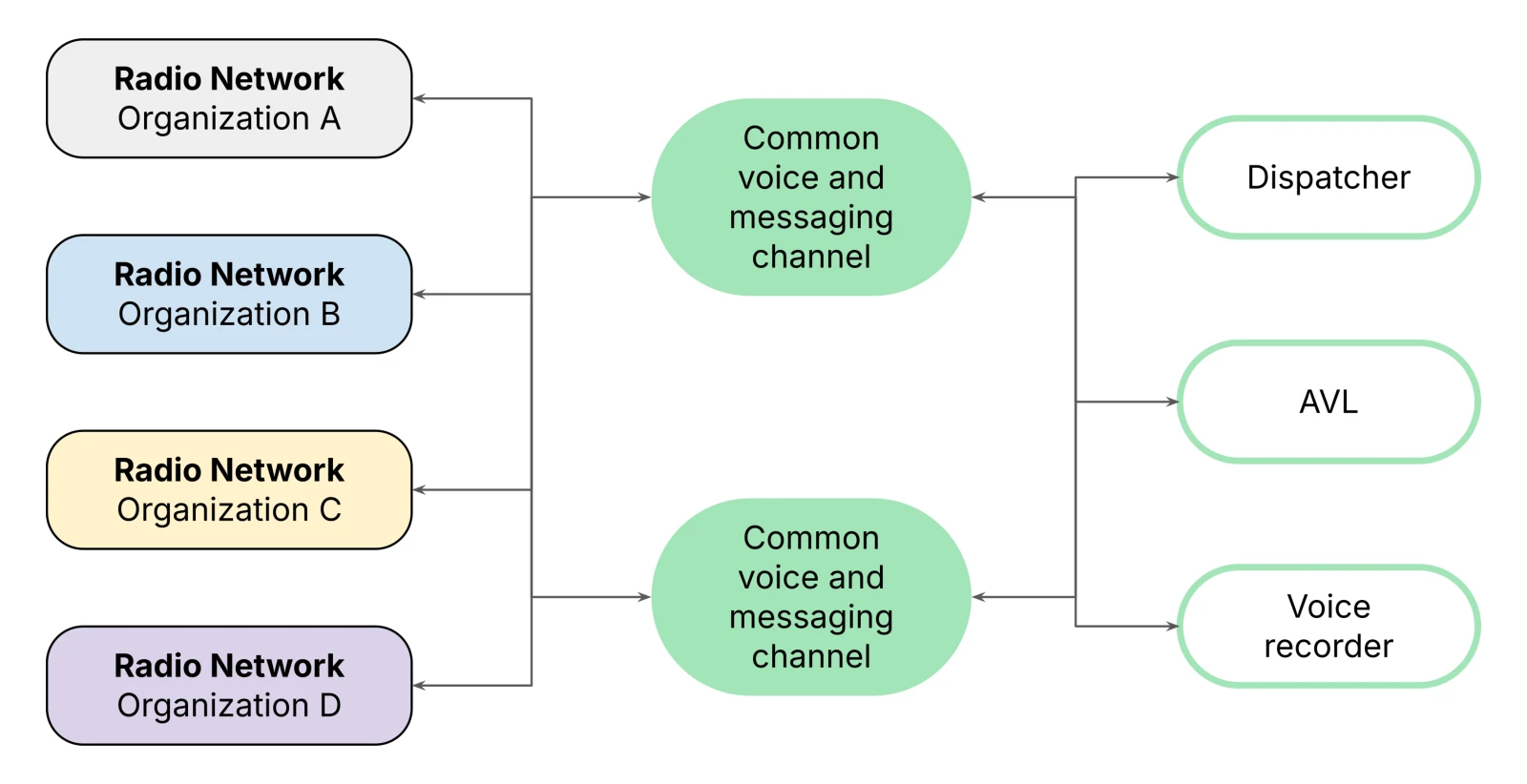
Diagram: Organization A's three networks (analog radio, digital radio, and PoC) converge on a shared voice and messaging channel. That channel communicates in both directions with the dispatcher, and both the channel and the dispatcher link to emergency numbers.
The three technologies converge on a shared channel, and the dispatcher brings in emergency services when needed.

Shared infrastructure across organizations

Several organizations working in the same area sometimes need to coordinate, but keep their communications separate the rest of the time. Each one has its own radio group and its own channel, with no access to the others' communications.

Omnifunk hosts these organizations on the same central infrastructure, with full logical separation between them: each organization only sees and hears its own traffic. When a joint operation or an emergency involving all of them comes up, the dispatcher opens a temporary shared channel for the organizations involved, without exposing the rest of their communications.

This architecture lowers infrastructure costs for each organization, since they share the server, gateway, and power backup, without giving up privacy in their day-to-day communications.

Diagram: four organizations (A, B, C, and D), each with its own radio network, are hosted on the same infrastructure and grouped into separate shared voice and messaging channels. Those channels connect to the shared dispatcher, AVL, and voice recorder.
Each organization keeps its own channel, and the dispatcher opens a shared channel only when the operation calls for it.

Radio technologies

Omnifunk integrates with the most widely used radiocommunications technologies and brands on the market:

Analog

  • Conventional FM
  • MPT1327
  • SSB

Digital

  • DMR
  • DMR Tier III
  • P25
  • NXDN
  • TETRA

Brands

  • Motorola Solutions
  • Hytera
  • Kenwood / JVCKENWOOD
  • Icom
  • Damm Cellular Systems
  • Teltronic
  • L3Harris
  • Sepura
  • Tait Communications
  • Airbus DS / Thales
  • Rohill
Don't see the technology or brand you're looking for? Talk to us →